How to Scale a Shopify Store from ₹5L to ₹1Cr Monthly Revenue — The Exact Playbook
Most Shopify stores in India plateau at ₹5–10 lakhs a month — not because of bad products, but because of missing systems. This pillar guide reveals the exact Akestech playbook — Audit → Strategy → Foundation → Launch → Scale — used to take D2C brands from ₹5L to ₹1Cr monthly revenue. Covers Meta & Google Ads, CRO, WhatsApp automation, operations, and every lever that actually moves revenue at scale.

Hitting ₹5 lakhs a month on Shopify feels incredible. You've validated your product, found your early customers, and proved there's a market. But then — growth stalls.
You pour more money into ads. ROAS drops. You try new creatives. Orders barely move. Your WhatsApp inbox is chaos. Your team is firefighting daily operations instead of scaling.
Sound familiar?
Here's the truth: ₹5L to ₹1Cr is not a traffic problem. It's a systems problem.
The stores that crack ₹1 crore a month aren't necessarily running more ads. They've built a growth engine — with the right ad strategy, conversion infrastructure, retention systems, and operational backend — all working together.
At Akestech, we've helped Indian D2C brands navigate this exact journey. And we've distilled it into a repeatable framework we call ASFLS: Audit → Strategy → Foundation → Launch → Scale.
This is that playbook — in full detail.
Why Most Shopify Stores Plateau at ₹5–10 Lakhs
Before we dive into the solution, let's understand the problem clearly.
Most D2C brands that plateau at ₹5–10L/month share the same set of bottlenecks:
- Ad spend scaling kills profitability — ROAS collapses as budgets increase because the targeting pool shrinks and frequency rises.
- Website converts at 0.8–1.2% — Industry leaders convert at 2.5–4%. That gap is costing you crores.
- Zero retention engine — 80%+ of revenue comes from new customer acquisition. No email. No WhatsApp flows. No loyalty structure.
- Operations aren't ready to scale — Shipping delays, inventory mismatches, and manual processes break down above a certain order volume.
- No data infrastructure — Decisions are made on gut feel, not attribution data, customer LTV, or cohort analysis.
Solving any one of these in isolation won't get you to ₹1Cr. You need to fix all five simultaneously, in the right sequence. That's what the Akestech framework is designed to do.
The Akestech Framework: ASFLS
Phase 1: Audit — Know Exactly Where You Are
You cannot scale what you haven't measured. The Audit phase is about creating complete visibility across every growth lever in your business.
What we audit:
A. Store Performance Audit
- Current conversion rate (CVR) by device and traffic source
- Add-to-cart rate, checkout initiation rate, and checkout completion rate
- Bounce rate and time-on-page by landing page
- Top exit pages in the funnel
B. Ads Account Audit
- Meta Ads: Campaign structure, audience overlap, creative fatigue, ROAS by campaign and ad set, frequency data
- Google Ads: Search term reports, shopping feed quality, Performance Max structure, keyword cannibalization
- Attribution model being used (last-click vs. data-driven) and its impact on reported ROAS
C. Revenue Quality Audit
- Average Order Value (AOV) vs. industry benchmarks
- Customer repeat rate and purchase frequency
- Return rate and its root causes
- Net revenue per order after returns, COD losses, and shipping
D. Retention Audit
- Email list size and open/click rates
- WhatsApp subscriber count and engagement
- Active post-purchase flows (welcome, abandoned cart, win-back)
E. Operations Audit
- Shipping SLA adherence
- RTO (Return to Origin) rate — this is a critical metric most brands ignore
- Inventory turnover and stockout frequency
- Customer support response time and ticket resolution rate
This audit typically reveals 3–5 critical bottlenecks. Fixing them in the right order drives the fastest revenue growth.
Our Shopify Store Audit service provides this end-to-end diagnostic for D2C brands ready to scale.
Phase 2: Strategy — Build Your 90-Day Revenue Roadmap
With audit data in hand, the Strategy phase translates insights into a prioritized growth plan.
The core output of this phase is a 90-Day Revenue Roadmap that defines:
- Revenue targets by channel — What percentage of ₹1Cr/month comes from paid acquisition vs. retention vs. organic?
- Budget allocation model — How should ad spend be distributed across Meta, Google, and influencer?
- CRO priority list — Which 5 website changes will move CVR the most?
- Retention calendar — Email and WhatsApp campaign schedule for the next 12 weeks
- Operational readiness checklist — What needs to be in place before scaling ad spend?
The ₹1Cr Revenue Mix (Benchmark)
Most high-performing Indian D2C brands at ₹1Cr/month generate revenue in roughly this ratio:
| Channel | Revenue Contribution |
|---|---|
| Meta Ads (prospecting + retargeting) | 40–50% |
| Google Ads (shopping + search + PMax) | 15–20% |
| WhatsApp & Email retention | 20–25% |
| Organic / Influencer / Referral | 10–15% |
If your current revenue is 90%+ dependent on paid acquisition, that's your single biggest scaling risk. The Strategy phase rebalances this.
Our D2C Growth Strategy service is built around creating this roadmap for brands in the ₹5L–₹50L range.
Phase 3: Foundation — Build the Systems That Support Scale
This is the most skipped phase — and the reason most scaling attempts fail.
Brands try to 10x their ad spend before their foundation can handle it. What follows is a brutal cycle of ads working, operations failing, customer experience breaking, reviews turning negative, and ROAS collapsing.
Foundation work is unglamorous but non-negotiable.
A. Conversion Rate Optimization (CRO)
At ₹5L/month with 1% CVR, fixing your store to 2.5% CVR effectively 2.5x your revenue without spending an extra rupee on ads. This is the highest-leverage work in the entire playbook.
Key CRO improvements for Indian D2C stores:
- Above-the-fold redesign — Hero image, headline, and CTA must communicate value proposition within 3 seconds. Most Indian Shopify stores fail this test on mobile.
- Product page trust stack — Star ratings, review count, UGC photos, secure payment badges, and return policy must be visible before the fold on mobile.
- Speed optimization — Every 1-second delay in page load time reduces conversions by ~7%. Target under 2.5 seconds on mobile (Google PageSpeed score 70+).
- Checkout friction removal — Enable Shop Pay, UPI, and COD. Indian shoppers have high COD preference. Removing friction at payment is a direct revenue driver.
- Social proof density — Indian shoppers are highly social-proof-driven. WhatsApp-style review cards, "X people bought this today" nudges, and video testimonials significantly increase trust and CVR.
- Sticky add-to-cart bars — Especially on long-scroll product pages, a persistent ATC button on mobile removes the need to scroll back up.
Our CRO & Shopify Optimization service executes all of the above with A/B testing to validate impact before full rollout.
B. WhatsApp Marketing Infrastructure
WhatsApp is the single most powerful retention and remarketing channel for Indian D2C brands. Open rates are 85–95%. CTRs are 15–30%. No other channel comes close.
Building this infrastructure during the Foundation phase means you'll have a working retention engine by the time ad spend scales.
The core flows to build:
- Abandoned cart recovery — 3-message sequence at 1hr, 12hr, and 24hr. Recover 12–18% of abandoned carts.
- Order confirmation + shipping updates — Builds trust, reduces WISMO (Where Is My Order) queries, and dramatically cuts support tickets.
- Post-delivery review request — Automate review collection at Day 5 and Day 10 post-delivery.
- Win-back campaign — Target customers who haven't purchased in 45–60 days with a personalized offer.
- Broadcast campaigns — Weekly or bi-weekly promotional broadcasts to your subscriber list for new launches, offers, and seasonal sales.
Platforms like Interakt, Wati, and AiSensy integrate directly with Shopify and can be configured to trigger these flows automatically.
C. Email Marketing Setup
While WhatsApp dominates in India, email marketing has a critical role — especially for premium brands and customers who prefer email.
Essential automated flows:
- Welcome series (3 emails over 7 days)
- Abandoned cart (3 emails)
- Post-purchase onboarding (teaches product use, builds loyalty)
- Win-back (45-day lapsed customers)
- Birthday / anniversary campaigns
Klaviyo is the gold standard for Shopify email integration.
Phase 4: Launch — Scale Paid Acquisition the Right Way
With a converting store and a retention engine in place, it's time to scale ads. Here's how to do it without destroying ROAS.
A. Meta Ads Strategy for Indian D2C Brands
Meta (Facebook + Instagram) remains the primary acquisition channel for most Indian D2C brands because of its unmatched audience targeting and creative flexibility.
Campaign architecture for scale:
Prospecting (60–70% of Meta budget)
- Broad targeting with strong creatives — Meta's algorithm has matured to the point where broad audiences often outperform interest-based targeting at scale.
- Advantage+ Shopping Campaigns (ASC) — Meta's AI-powered campaign type that automatically optimizes across audiences and placements. Works well for brands with sufficient conversion data (50+ purchases/week).
- Creative variety is critical — Test static images, carousel, UGC-style video, and reels. Most winning ads in India are UGC-format or problem-agitation-solution videos in Hindi or regional language.
Retargeting (30–40% of Meta budget)
- Segment by funnel stage: product viewers (last 7 days), add-to-cart (last 3 days), checkout abandoners (last 1 day).
- Dynamic Product Ads (DPA) for catalogue retargeting — these personalize the ad with the exact product the user viewed.
- Keep retargeting audiences fresh — if frequency exceeds 5–6, refresh creatives or expand the audience window.
Creative testing cadence:
- Test minimum 3–5 new creatives per week at ₹500–1000/day per ad set.
- Scale winners: Double budget every 3–4 days if ROAS holds.
- Kill losers quickly: If a creative spends 2x CPA with zero purchase, turn it off.
B. Google Ads Strategy
Google captures demand that already exists — users actively searching for what you sell. For most D2C brands, Google contributes 15–25% of total revenue and is critical for profitability because search intent is high and return rates are lower.
Shopping campaigns:
- Google Shopping is often the highest-ROAS campaign type for product-based businesses.
- Feed quality matters enormously — optimize product titles with brand + category + key attributes (e.g., "Organic Kashmiri Almond Oil 100ml — Cold Pressed — Akestech").
- Performance Max (PMax) campaigns combine shopping, search, display, and YouTube under one campaign. Use them once you have 30+ purchases/month for Google's algorithm to learn effectively.
Search campaigns:
- Target high-intent branded + category keywords.
- Protect your brand name — competitors may bid on it.
- Use exact match for top-performing keywords to control spend.
Our Performance Marketing service manages Meta and Google campaigns with a full creative production pipeline for Indian D2C brands.
C. Influencer & UGC Strategy
At the ₹1Cr level, paid media alone is rarely enough. Influencer and UGC content serve two purposes: driving direct sales and generating creative assets for paid ads.
- Partner with 10–20 micro-influencers (10K–100K followers) in your niche per month. These typically deliver better ROI than one mega-influencer deal.
- Always get usage rights for the content — repurpose top-performing influencer content as Meta ad creatives.
- Build a UGC program — incentivize customers to create content post-purchase with discounts or loyalty points.
Phase 5: Scale — The Operating System for ₹1Cr/Month
Scaling to ₹1Cr isn't just about marketing. It requires the operating infrastructure to fulfill, retain, and profitably manage 1,500–3,000 orders per month.
A. Operations at Scale
At ₹1Cr/month, manual operations become a critical bottleneck. Key operational systems to have in place:
- Inventory management — Use tools like Unicommerce or Increff to manage multi-warehouse inventory, prevent stockouts, and automate purchase orders.
- Shipping optimization — Integrate a multi-courier platform (Shiprocket, Pickrr, or Delhivery Direct) with auto-routing to reduce shipping costs and improve delivery speed.
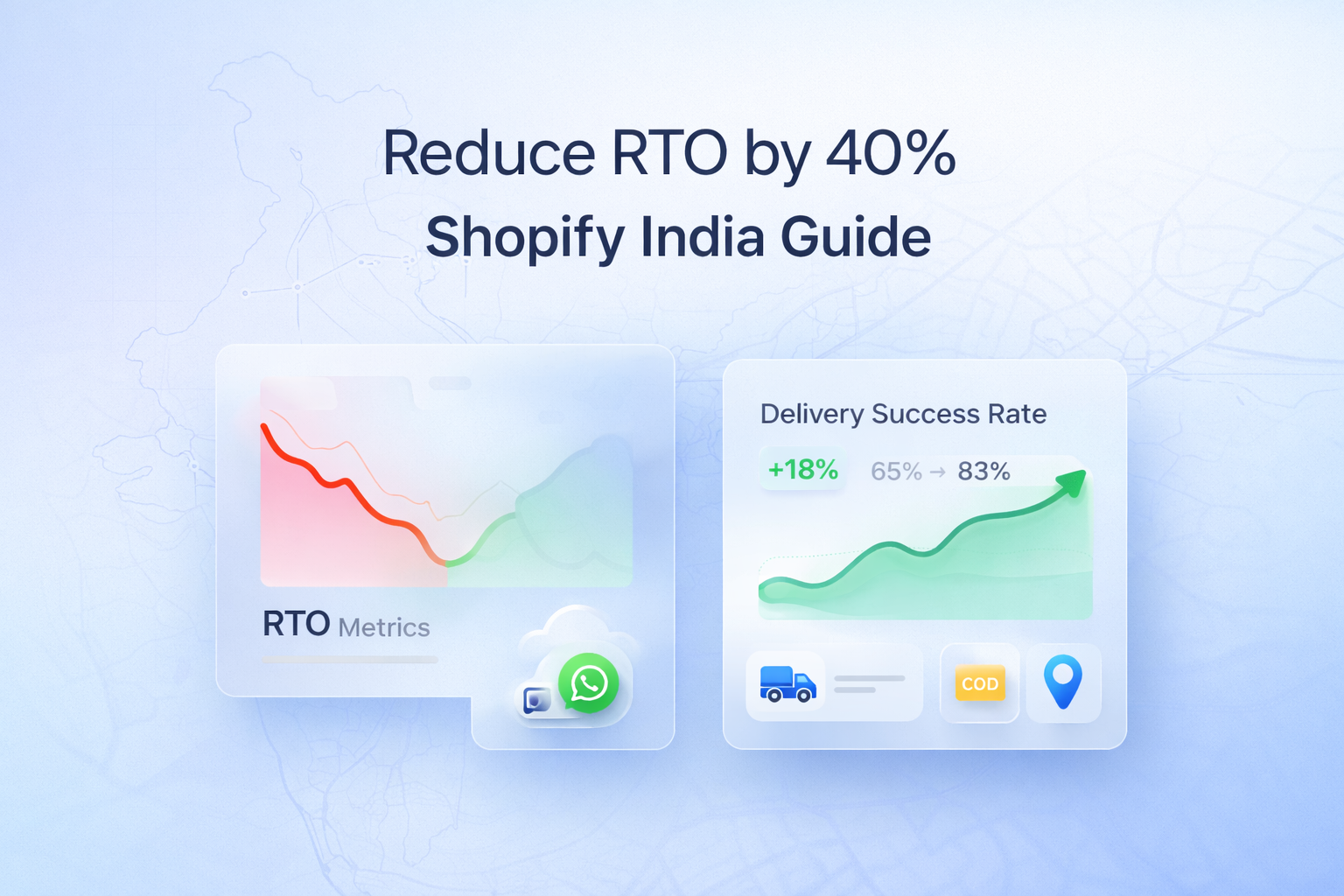
- RTO reduction — India's RTO rates can be 25–40% for COD-heavy brands. Use address verification, IVR confirmation calls, and NDR (Non-Delivery Report) management to get RTO below 15%.
- Customer support — Implement a helpdesk (Freshdesk, Gorgias) with pre-built macros for WISMO, returns, and exchange queries. Target first-response time under 2 hours.
B. Data & Analytics Infrastructure
At this revenue level, decision-making must be data-driven. Build your analytics stack:
- Shopify Analytics — Monitor CVR, AOV, returning customer rate, and revenue by traffic source daily.
- GA4 + Enhanced Ecommerce — Full funnel visibility from acquisition to purchase.
- Meta Ads + Google Ads attribution — Use UTM parameters consistently. Consider a third-party attribution tool (Northbeam, Triple Whale) if budget allows.
- Customer LTV dashboard — Track LTV by acquisition cohort and channel to understand true profitability.
- Weekly KPI review — Revenue, ROAS, CVR, AOV, RTO rate, repeat purchase rate. Every scaling decision should be anchored in these numbers.
C. Team Structure for Scale
Trying to run a ₹1Cr/month brand solo is a bottleneck in itself. The minimum team structure:
- Performance marketing manager or agency
- Creative designer + video editor
- Customer support (1–2 agents)
- Operations / fulfillment manager
- Retention marketer (email + WhatsApp)
If you're not ready to hire in-house, a full-stack D2C growth agency like Akestech can provide all of these functions under one roof.
Our Full-Stack D2C Management service covers everything from ads to operations for brands serious about scaling to ₹1Cr and beyond.
The ₹5L to ₹1Cr Growth Timeline — What to Expect
Here's a realistic milestone framework based on brands that have used this playbook:
| Month | Milestone | Key Focus |
|---|---|---|
| Month 1–2 | Audit complete, Foundation built | CRO, WhatsApp setup, email flows live |
| Month 2–3 | ₹10–15L/month | Meta ads scaling, creative testing |
| Month 3–4 | ₹20–30L/month | Google Shopping live, retention kicking in |
| Month 4–5 | ₹40–50L/month | PMax campaigns, influencer UGC, RTO optimized |
| Month 5–6 | ₹75L–₹1Cr/month | Full funnel operating, data-driven scaling |
This is not a guarantee — results depend on product-market fit, margins, and execution quality. But this is a realistic pace for brands that commit to all five phases.
Key Metrics to Track on Your Way to ₹1Cr
Here are the benchmarks your store should hit at each revenue level:
| Metric | ₹5L/month | ₹30L/month | ₹1Cr/month |
|---|---|---|---|
| Conversion Rate | 0.8–1.2% | 1.8–2.2% | 2.5–3.5% |
| AOV | ₹600–800 | ₹800–1000 | ₹900–1200 |
| ROAS (Meta blended) | 2.5–3x | 3–4x | 3.5–5x |
| Repeat Purchase Rate | 10–15% | 20–25% | 30–35% |
| RTO Rate (COD) | 30–40% | 20–25% | 12–18% |
| WhatsApp CVR (abandoned cart) | — | 8–12% | 14–20% |
| Email Revenue Contribution | — | 5–8% | 10–15% |
If your numbers are significantly below these benchmarks at any stage, that's where to focus next.
Common Mistakes That Kill Shopify Scaling Attempts
Avoid these mistakes — they're responsible for most failed scaling attempts:
1. Scaling ads before fixing CVR Pouring ₹5L/month in ad spend into a 0.8% converting store is burning money. Fix CVR first. Every 0.5% improvement to CVR is worth more than doubling ad spend.
2. Ignoring RTO An RTO rate of 35% on COD orders destroys profitability at scale. Shipping cost + return handling + inventory damage can wipe out margins entirely. Get RTO below 18% before scaling.
3. Single creative dependency Scaling Meta ads without a continuous creative pipeline guarantees creative fatigue and ROAS collapse within 4–6 weeks. You need to be testing 3–5 new creatives every week.
4. No post-purchase flow Most stores spend ₹300–500 to acquire a customer and then do nothing to retain them. A simple 3-email post-purchase flow with a second-purchase incentive can lift repeat rate by 15–20%.
5. Attributing all revenue to last-click Meta Ads and Google Ads both claim credit for the same orders. Without proper attribution, you'll make wrong budget decisions. Use UTM tracking and consider 1-day click + 1-day view attribution on Meta to avoid overcounting.
How Akestech Helps D2C Brands Scale to ₹1Cr
At Akestech, we specialize in helping Indian D2C brands build the complete infrastructure required to scale profitably.
Our service stack covers every phase of the ASFLS framework:
- ? Shopify Store Audit — Full diagnostic of your store, ads, and retention systems
- ? D2C Growth Strategy — 90-day roadmap built on your data
- ? Performance Marketing — Meta & Google Ads management with in-house creative
- ⚡ CRO & Store Optimization — Data-driven conversion rate improvements
- ? Full-Stack D2C Management — End-to-end growth management for serious brands
We work with a limited number of brands each month to ensure deep focus and measurable results. If you're at ₹5L–₹50L/month and ready to scale, book a free strategy call with our team.
Final Thoughts
Scaling a Shopify store from ₹5L to ₹1Cr monthly revenue is one of the most exciting — and demanding — journeys in Indian D2C. It requires building multiple systems simultaneously, making data-driven decisions, and executing with consistency over several months.
The brands that make it aren't just the ones with the best products. They're the ones that build the full growth engine: a converting store, a diversified acquisition strategy, a retention system that keeps customers coming back, and operations that can handle the scale.
The Akestech ASFLS framework — Audit, Strategy, Foundation, Launch, Scale — is the exact sequence we've used to help Indian D2C brands achieve this. If you're ready to build this engine for your brand, get in touch with our team today.