
Shopify CRO Checklist for Indian Brands
A step-by-step Shopify CRO checklist for Indian D2C brands: fix checkout drop-off, add UPI/COD, and turn visitors into buyers.
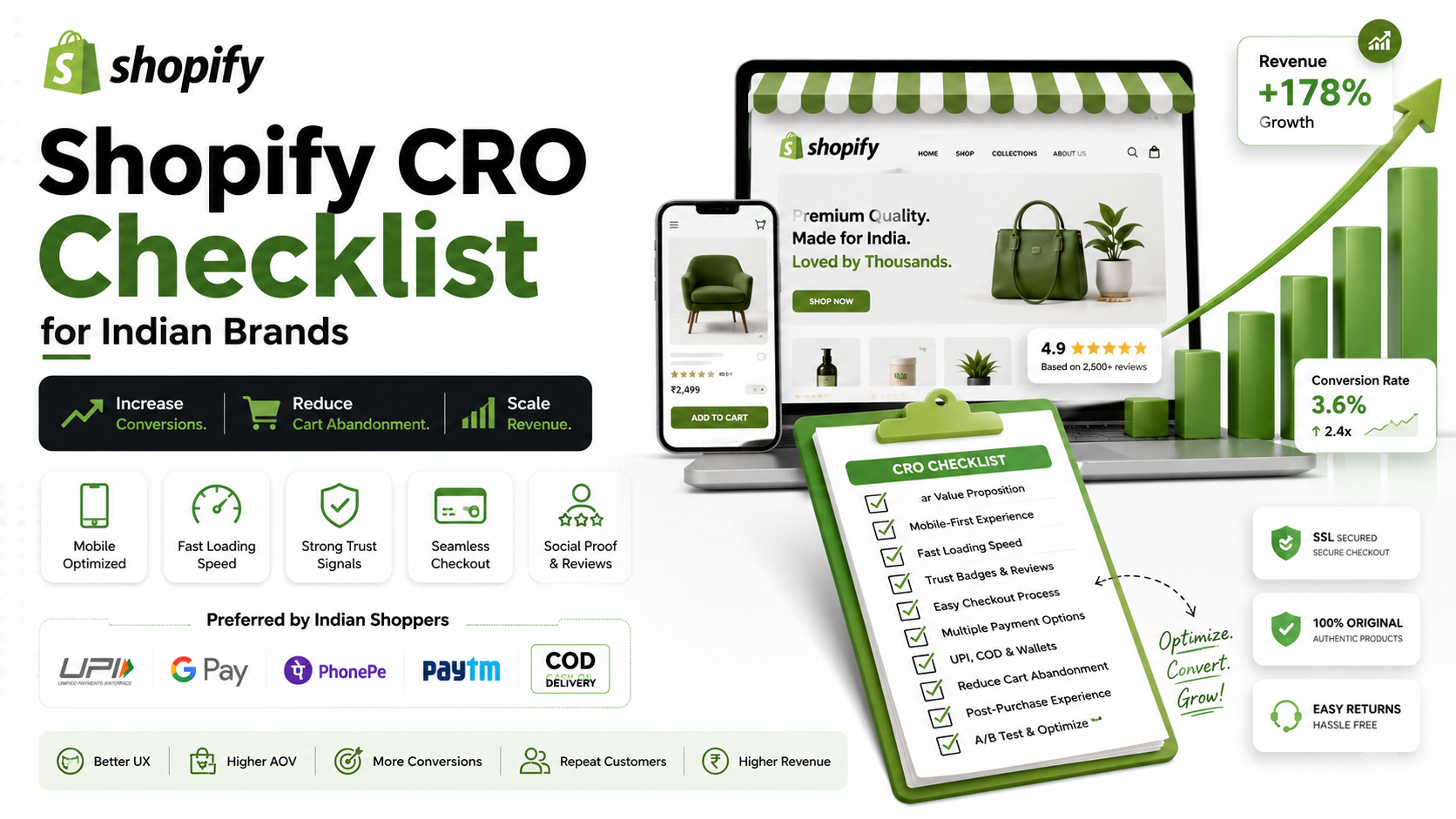
Raghav builds a skincare brand on Shopify, runs Instagram ads every day, and watches the traffic graph climb. Sessions are up 40% this quarter. Revenue is flat. He checks Shopify Analytics and finds the number that explains everything: a 0.9% conversion rate, while his closest competitor is sitting comfortably above 3%.
This is not a traffic problem. It is a conversion problem, and it is one of the most common stories among Indian D2C founders right now. Ad costs keep rising, but the store itself is quietly leaking sales at every step, from a slow homepage to a checkout that does not feel built for an Indian shopper.
A Shopify CRO checklist is a structured audit of every step a visitor takes, from landing page to "thank you" page, designed to find and fix the exact points where people leave without buying. For Indian brands, that means going beyond the generic, US-built advice and addressing local realities: UPI, Cash on Delivery, patchy 4G in tier-2 and tier-3 cities, and a shopper who trusts a brand only after seeing real proof.
Where Indian Shopify stores actually stand
Before fixing anything, it helps to know the real numbers. Shopify's platform-wide average conversion rate sits around 1.4%, while a genuinely well-optimized store typically lands between 2.5% and 3.5%, and the top 10% of stores convert above 4.7%. For Indian stores specifically, industry data shows checkout completion rates of roughly 35-45%, well below the 65-75% seen in the US and Europe, and the gap is almost entirely payment friction. Add in a cart abandonment rate near 70% and return rates of 25-35% on fashion and apparel, and the picture is clear: small, India-specific fixes carry outsized impact.
1. Homepage & Navigation
- Lead with the offer, not the logo. Your value proposition (what you sell, who it's for, why it's different) should be visible without scrolling, in plain language, not a tagline.
- Make search and category navigation thumb-friendly. Most Indian Shopify traffic is mobile-first, so a cluttered hamburger menu or buried search bar costs you visitors in the first five seconds.
- Show price range and bestsellers early. Indian shoppers are price-conscious; hiding pricing behind clicks adds friction instead of mystery.
- Keep load time under 2.5 seconds on 4G. A one-second delay on a typical Indian mobile connection can quietly cut conversions before the page even finishes rendering.
2. Product Pages
- Use real product photos and short videos, not just studio shots. Indian buyers shop heavily on Instagram and TikTok-style content; a 15-second usage video on the PDP builds more trust than five static images.
- Answer sizing and fit questions on the page itself. For apparel and footwear, an Indian-specific size chart (not a US/UK conversion table) reduces both hesitation and returns.
- Display stock and delivery estimates by pincode. "Delivers by Thursday to 110001" converts better than a generic "3-5 business days."
- Put reviews and ratings above the fold on mobile. Star ratings with photo reviews are one of the highest-leverage trust signals for first-time Indian buyers.
3. Trust & Social Proof
- Show a visible, easy return and exchange policy. Indian shoppers buying from an unfamiliar brand check this before checking the price.
- Add WhatsApp or chat support as a visible option. It is the most-used app in India, and a WhatsApp Business link next to "Add to Cart" reduces pre-purchase doubt instantly.
- Display secure payment and GST invoice mentions near checkout. Small trust badges and a clear note about GST-compliant billing matter more for first-time buyers than seasoned Western shoppers.
- Feature real customer photos (UGC) over polished influencer content. Authenticity outperforms aspiration for most mid-market Indian categories.
4. Cart Experience
- Use a sticky cart and a real-time free-shipping progress bar. "Add ₹299 more for free delivery" is one of the simplest AOV and conversion levers available.
- Allow quantity and variant edits inside the cart. Forcing a return to the product page to change size or color is a common, fixable leak.
- Surface low-effort upsells, not aggressive ones. A relevant ₹199 add-on at the cart stage converts; a pop-up demanding attention does not.
- Trigger an exit-intent offer only once, never repeatedly. Indian mobile users abandon faster when interrupted more than once per session.
5. Checkout & Payments (India-Specific)
This is where most Indian Shopify stores lose the most money, and where generic CRO checklists fall short.
- Make UPI the default, one-tap payment option. UPI now drives the majority of online ecommerce payment volume in India, and Google Pay, PhonePe, or Paytm should be the first thing a shopper sees, not buried under card fields.
- Offer Cash on Delivery, but make prepaid more attractive. COD still accounts for a meaningful share of orders, especially in tier-2/3 cities, but a small prepaid discount or "pay ₹49 now, rest on delivery" nudge improves cash flow and reduces fake orders.
- Enable EMI for higher AOV products. For categories above ₹3,000-5,000, EMI options through your payment gateway noticeably lift completion rates.
- Add pincode-based address autofill. Manual address typing on a small screen is a top checkout abandonment trigger; pincode lookup removes most of that typing.
- Allow guest checkout by default. Forcing account creation before purchase is still one of the most common, most avoidable conversion killers.
6. Mobile Speed & Performance
- Pass Core Web Vitals on real Indian network conditions, not just Wi-Fi. Test on throttled 4G, since a large share of your traffic genuinely shops on it.
- Compress and lazy-load every image. Heavy, uncompressed product images are the single most common cause of slow Shopify storefronts.
- Limit third-party apps and scripts. Every extra review widget or pop-up app adds load time; audit and remove anything not actively driving revenue.
- Test the Shop app and PWA experience separately. A growing share of repeat Indian shoppers browse through the Shop app, and it deserves its own speed and UX check.
7. Post-Purchase & Retention
- Send order and delivery updates via WhatsApp, not just email. Open rates on WhatsApp updates are dramatically higher than email for Indian customers.
- Make returns and exchanges self-serve. A simple returns portal reduces support load and increases repeat-purchase confidence.
- Recover abandoned carts with SMS and WhatsApp, not only email. Email open rates are low for many Indian shoppers; a well-timed WhatsApp nudge often outperforms it.
- Reward repeat buyers with a visible loyalty perk. Even a simple "Get 10% off your next order" note on the thank-you page increases repeat purchase rate.
Quick-Reference Checklist
Homepage loads under 2.5s on 4G · Clear value prop above the fold · Pincode-based delivery estimates on PDP · Reviews visible without scrolling · WhatsApp support link present · Sticky cart with free-shipping bar · UPI set as default payment · COD available with prepaid nudge · EMI on high-AOV products · Pincode autofill at checkout · Guest checkout enabled · Core Web Vitals tested on throttled 4G · WhatsApp order updates active · Self-serve returns portal live · WhatsApp/SMS cart recovery flow running
FAQs
What is a good conversion rate for a Shopify store in India? Anything above 2-2.5% is solid for most categories, and above 3.5% puts you in the top tier. Compare against your own category (fashion, beauty, electronics) rather than a single blended average, since "good" varies widely by industry and price point.
Why is my Shopify store getting traffic but no sales? The most common causes are checkout friction (missing UPI, forced account creation, slow load on mobile), weak trust signals for first-time buyers, and unclear delivery or return information. Run through the checklist above section by section to isolate the leak.
Does Cash on Delivery hurt or help conversion rates in India? COD increases order volume by removing payment hesitation, but it also raises RTO (return-to-origin) and fake-order risk. The best-performing Indian Shopify stores keep COD available while nudging shoppers toward prepaid with small discounts or partial-payment options.
How do I add UPI payment to my Shopify store? Most Indian payment gateways that integrate with Shopify, including Razorpay, Cashfree, and PayU, support UPI out of the box. Once connected, set UPI as the first or default option in your checkout payment list rather than leaving it under "more options."
What is the single most important page to optimize first? Checkout, by a wide margin. It is the closest point to revenue, and in India it typically has the largest gap versus global benchmarks, so small fixes here usually produce the fastest, most measurable lift.
How often should I re-run this CRO checklist? Quarterly at minimum, and immediately after any major traffic shift, new product launch, or seasonal sale, since new visitor segments often expose friction points that didn't show up before.
Raghav's real fix wasn't a bigger ad budget. It was working through this checklist section by section over three weeks: UPI moved to the top of checkout, a pincode-based delivery estimate went on every product page, and a WhatsApp link replaced a buried contact form. His conversion rate didn't need to hit 5% to change the business; it needed to stop leaking the customers his ads were already paying for.
That is the real promise of a CRO checklist: not a redesign, but a series of small, specific fixes that compound. Start with checkout, move to mobile speed, then trust signals, and revisit the list every quarter as your store and your traffic evolve.


